

When you hear the word ADHD, what comes to mind?
Maybe it's someone who can't sit still, loses their keys approximately 12 times a day, or has 47 tabs open on their computer (and insists every single one is absolutely necessary).
And sure, ADHD can look like that.
But it can also look like sitting on the couch for an hour, thinking about how badly you need to get up and shower… while continuing to sit on the couch.
Or avoiding a five-minute task for three weeks because your brain has decided that sending one email is the equivalent of climbing Mount Everest.
Or getting irrationally irritated when someone asks you one more question after a long day. (Respectfully, the brain has closed for business.)
ADHD is so much more than getting distracted. And understanding what's happening beneath the surface can change how we respond to ourselves.
"I Know What I Need to Do… So Why Can't I Just DO IT?"
Ah yes. The million-dollar question.
You know the laundry needs to be done.
You know the deadline is tomorrow.
You've been meaning to book that appointment for approximately 17 business days.
And yet… nothing.
ADHD can affect executive functioning, which is essentially your brain's management system. It helps with starting tasks, planning, prioritizing, remembering things, and regulating attention.
Think of it as the project manager of your brain.
Except sometimes the project manager has gone on vacation, left no instructions, and isn't answering emails.
So while it might look like laziness or procrastination from the outside, what's happening internally can be much more complicated.
Instead of asking:
"Why am I so lazy?"
Try asking:
"Okay, I'm stuck. What would make this easier to start?"
One creates shame. The other creates curiosity.
And your brain has probably received enough criticism already.
The ADHD Overwhelm Cycle (AKA Why Cleaning Your Kitchen Feels Like Climbing a Mountain)
Picture this.
You decide you're finally going to clean your apartment.
Easy enough, right?
Except "clean the apartment" actually means dishes, laundry, recycling, vacuuming, changing the sheets, and dealing with that pile that's slowly become a permanent member of the household.
Suddenly, your brain goes:
Absolutely not. Best of luck, though.
So you sit down for a quick break, open TikTok, and somehow 45 minutes disappear.
Now the apartment is still messy, your stress is higher, and your inner critic is thriving.
Sound familiar?
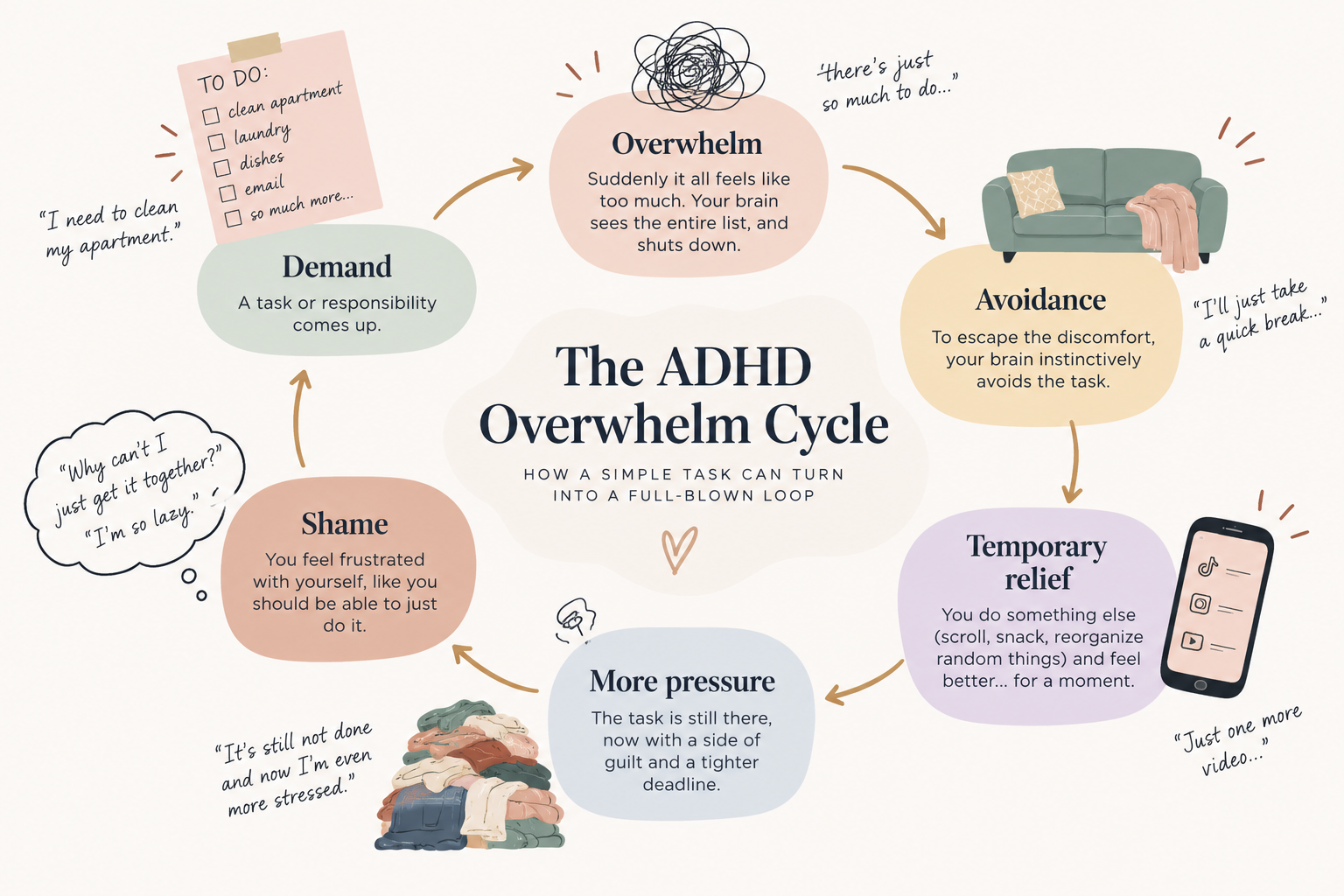
This is the ADHD overwhelm cycle:
Demand → Overwhelm → Avoidance → Temporary Relief → More Pressure → Shame → More Overwhelm
Insert ADHD Overwhelm Cycle infographic here.
Here's the thing: sometimes the answer isn't trying harder. It's making the starting point smaller.
Instead of "clean the kitchen" → put three dishes away.
Instead of "finish my assignment" → open the document.
Instead of "get my entire life together" → maybe let's not start there.
Ask yourself: What's one thing that would make this feel just 5% easier?
Sometimes a tiny bit of momentum is exactly what we need.
Plot Twist: ADHD Can Be Emotional, Too
ADHD doesn't just show up when you're trying to finish a spreadsheet or remember where you put your phone.
It can show up in your relationships, too.
Maybe frustration goes from 0 to 100.
Maybe you're overstimulated, and someone asking "What's for dinner?" feels like your final straw.
Or maybe someone gives you constructive feedback, and suddenly your brain is telling you they hate you, you're terrible at everything, and you should probably move to a remote island.
Many people with ADHD also experience difficulties with emotional regulation.
And when your nervous system is already running on empty, even small things can feel BIG.
One tool I encourage clients to practice is:
Notice → Pause → Name → Choose
Notice: What's happening in my body?
Pause: Do I need to respond right now?
Name: What am I actually feeling underneath this reaction?
Choose: What response would help me here?
You won't do this perfectly every time.
Sometimes you'll remember three hours later while replaying the conversation in the shower.
That's okay. We're practicing, not auditioning for World's Most Emotionally Regulated Human.
When "I Struggle With This" Becomes "There's Something Wrong With Me"
Okay, jokes aside for a moment.
This might be the part of ADHD I care about most as a counsellor.
After years of struggling with things that seem to come easily to other people, it's easy to develop some pretty painful beliefs about yourself.
Suddenly:
"I procrastinated" becomes "I'm lazy."
"I forgot something" becomes "I'm unreliable."
"I got overwhelmed" becomes "I'm incapable."
"I reacted emotionally" becomes "I'm too much."
See what's happening?
We're no longer describing something that happened. We're describing who we believe we are.
And that distinction matters.
What if procrastination isn't a character flaw?
What if struggling with consistency doesn't mean you don't care?
What if you've spent years being hard on yourself for something you didn't fully understand?
Understanding ADHD isn't about making excuses. It's about replacing shame with information.
Because when we understand why something is difficult, we can start finding strategies that actually help.
A Little Reminder Before You Go
There is no magical planner, productivity hack, or 5 a.m. morning routine that's going to work for every ADHD brain.
Sometimes you need smaller steps, visual reminders, timers, or body doubling.
Sometimes you need to regulate your nervous system before tackling your to-do list.
And sometimes the work isn't about productivity at all.
It's about learning to separate:
"This is something I struggle with."
from
"This is who I am."
You don't need to become someone without ADHD.
You get to learn how to work with your brain instead of constantly fighting against it.
And maybe give yourself a little more credit along the way.
Want Some Support Figuring Out Your ADHD?
If you found yourself nodding along, laughing a little, or thinking "Okay, why does this feel personally targeted?" while reading this, counselling might be a helpful place to explore how ADHD shows up in your life.
Together, we can explore overwhelm, emotional regulation, anxiety, self-esteem, and those frustrating "I know what I need to do, so why can't I just do it?" moments.
You don't have to figure it all out on your own. Book a free 15-minute consultation with Alexandra and learn more about how to work with ADHD.
